
The Inspiration
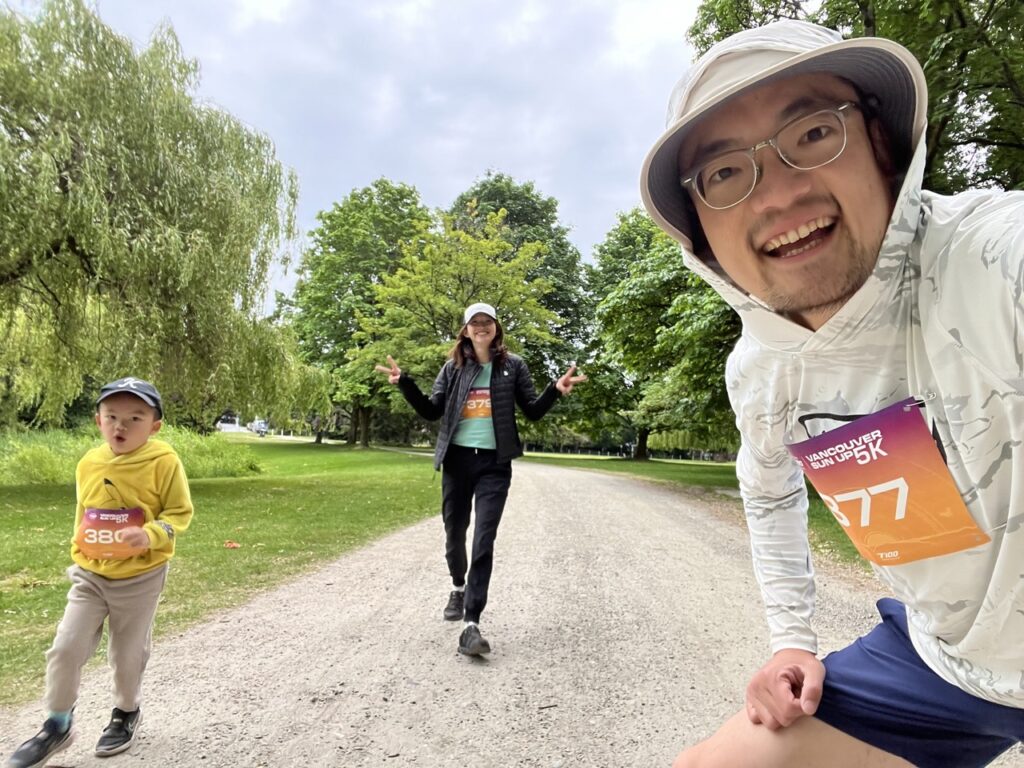
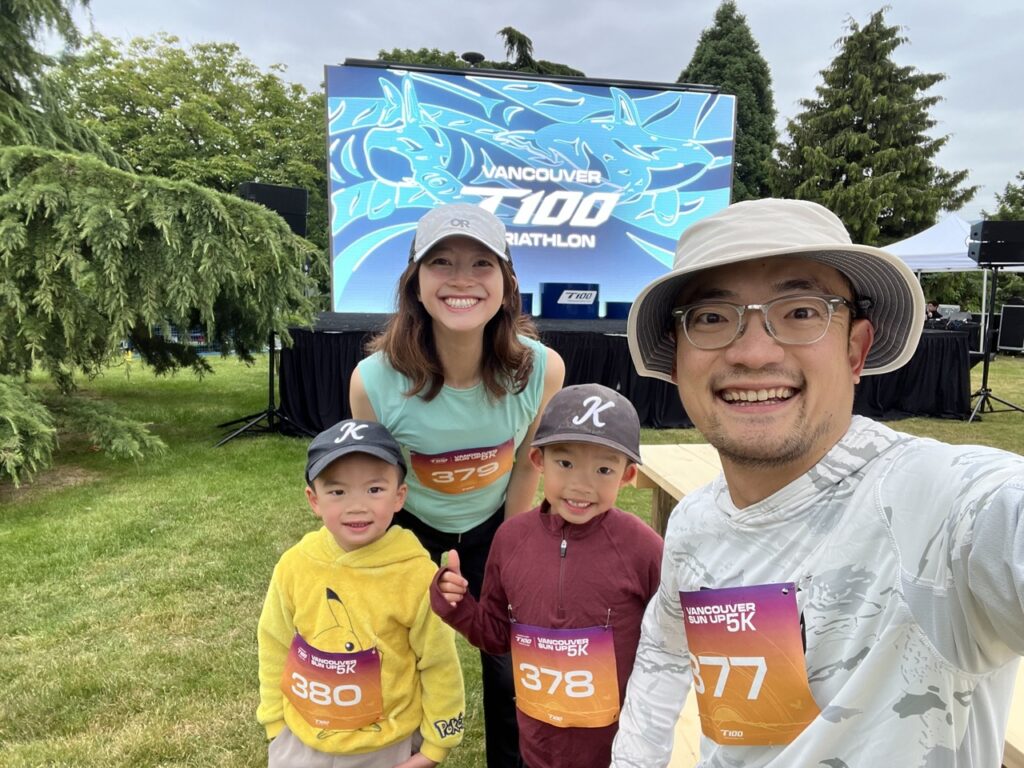
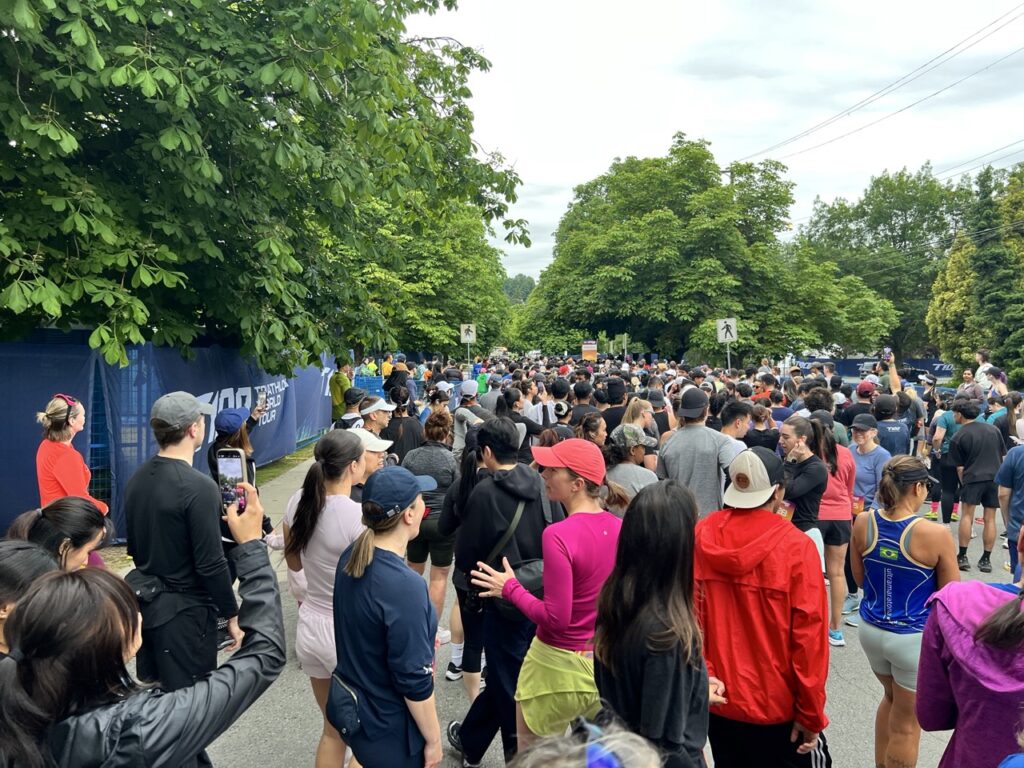
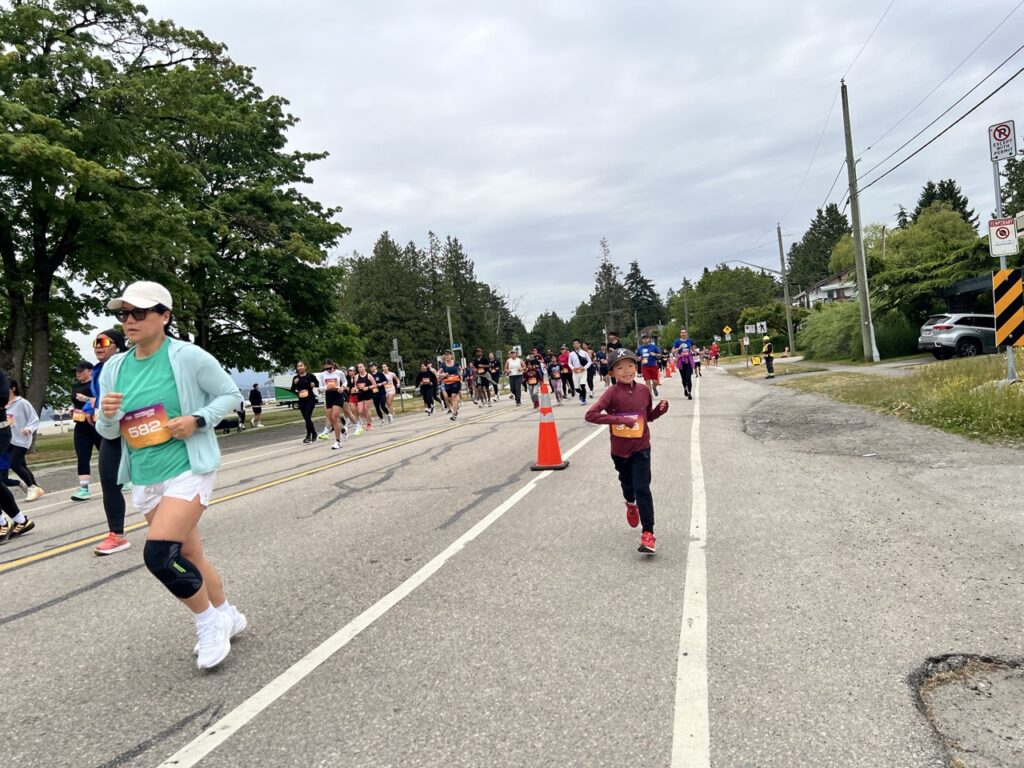
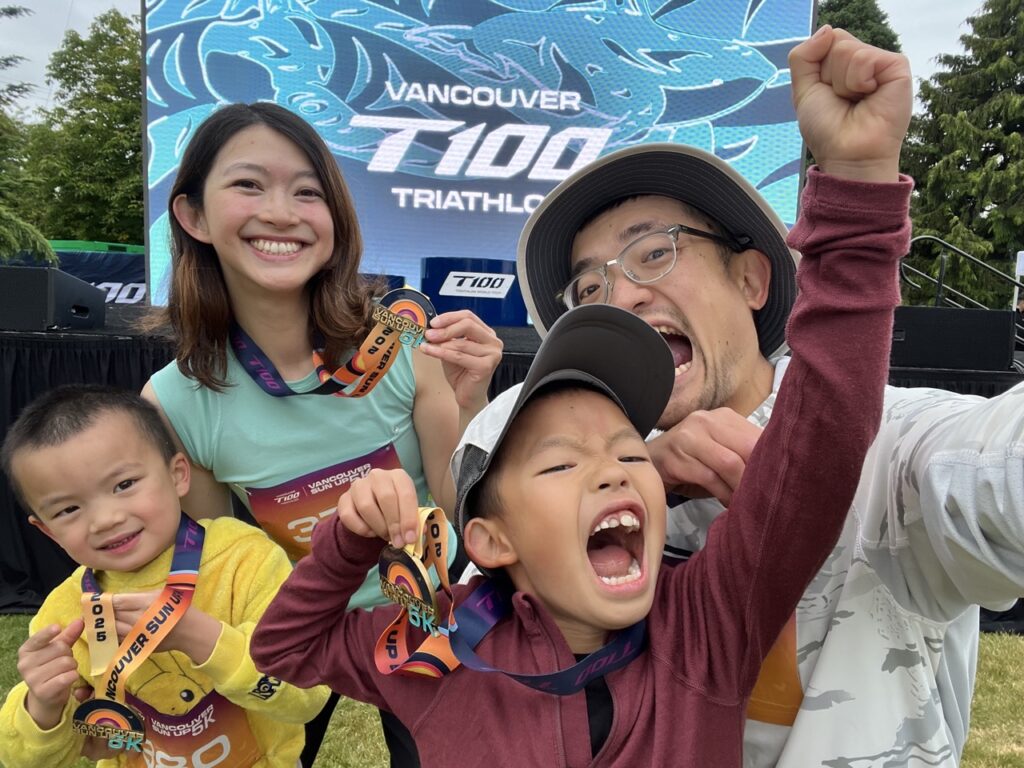
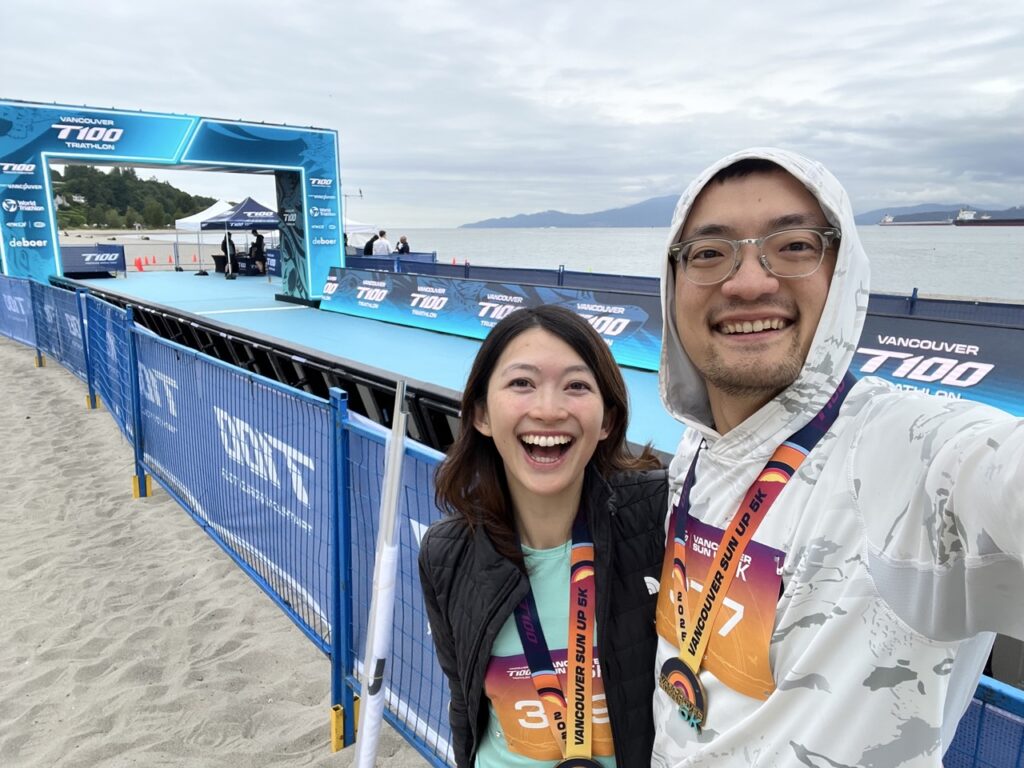
I’m starting this entry with a little travel back in time to string together the story. In 2025, we started doing running races as a family. Tina found a free 5K run as part of the first T100 race weekend in Vancouver called the Sun Up 5K and signed the whole family up.


The 5K was pure fun, and the overall energy around the T100 Expo was electric. We stayed afterward and watched the pros duking it out in their over-the-top gear, ridiculously aerodynamic bikes and helmets, and skin-tight race suits. Somewhere in there, the seeds of maybe we can do this too were planted.
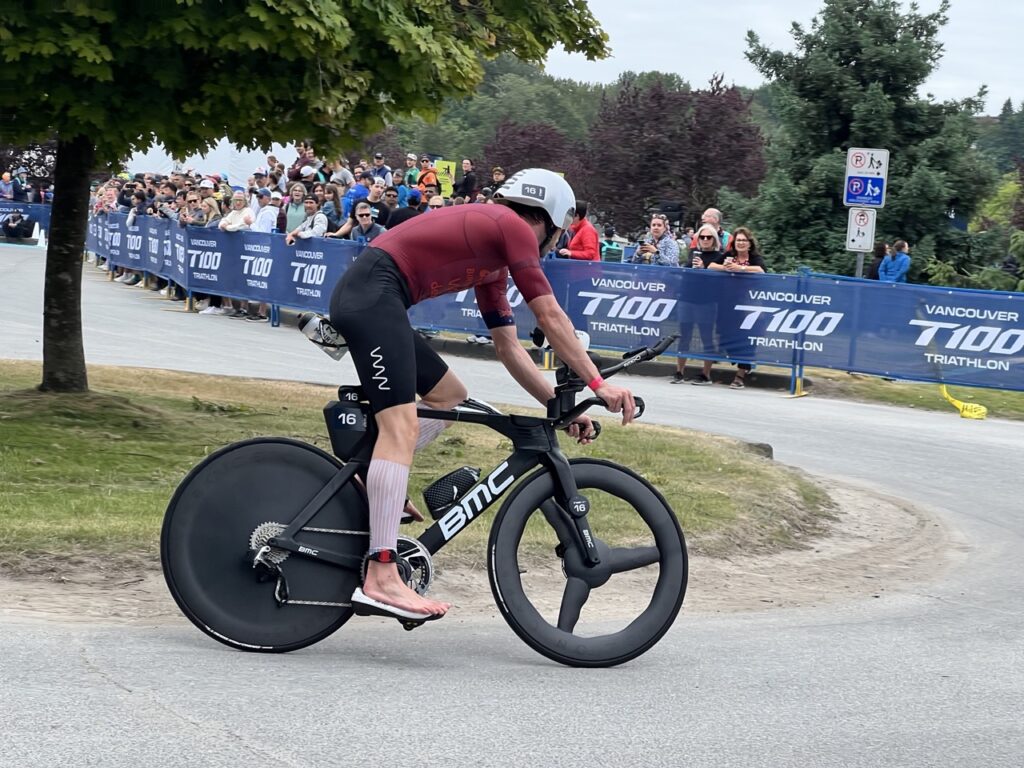
I went home and looked up just how difficult a triathlon actually was. The sprint distance consists of roughly a 750m swim, 20km bike, and 5km run, and the distances only go up from there. I knew I could bike 20km and run 5km, even though I had never done them back-to-back.
But swimming 750m continuously sounded completely bonkers.
Learning to Swim
My baseline swimming ability was poor. I enjoyed puddling around doing breaststroke, but I had hardly ever swum for exercise. Way back in our university days, Tina and I formed a relay team for UBC Storm the Wall and somehow I was chosen to be the swimmer. I remember that swim vividly because I felt like I just about died. I resorted to breaststroke for pretty much the whole event, finished dead last, and came out with blacked-out, tunnelled vision and severe dizziness. I had to lie down on a bench for several minutes before I felt steady enough to continue.
The distance that nearly destroyed me? About 200m.
As I read in a triathlon book, “swimming is the reason why more people don’t do triathlons.” But I was determined to not be one of them.
After a brief deliberation, I signed up for the UBC Tri Du sprint triathlon for March 2026 and also booked private adult swimming lessons for September to really work on my weakest discipline. Tina joined me for the swim lessons too, although she didn’t feel ready to sign up for a triathlon yet.
Thankfully, our swim coach was super nice and positive. That’s probably one of the most important qualities for an adult beginner swim instructor, because the last thing you’d want is to feel embarrassed about being bad at something you’re trying to learn. I distinctly remember barely managing a couple of lengths in the 25m pool before having to stop, and I dreaded going to the 50m pool because there was suddenly no wall halfway across to save me.
Sometimes I would start a length doing front crawl and switch to breaststroke halfway through because I was running out of air. My coach learned what was happening and knew when to ease off. My heart rate and breathing would spike into an unsustainable Zone 3 or 4 regardless of how slowly I tried to swim. The problem was that I didn’t actually know how to swim any slower. If I slowed down much more, I felt like I would sink.
In hindsight, that was one of the first important technical lessons from the year. Being reasonably fit from running doesn’t automatically make you an efficient swimmer. With poor technique, slowing down can actually feel harder. My legs would sink and create more drag, I kicked too much, my breathing wasn’t automatic, and every inefficiency required more effort. Then I would breathe harder, tense up and swim even less efficiently.
The solution wasn’t just to keep swimming myself into exhaustion. I had to learn how to make swimming easier. My social media feeds started getting populated with swimming lessons and tips, and I slowly got a hang of it.
Pool Swim Progression
I dutifully logged time in the pool. Two days a week, then three during my peak training weeks. I looked for swimming pools on vacation and swam laps at hotels. I even picked up swimming headphones and loaded them with very slow, relaxing music around 60–80 beats per minute in an attempt to stop myself from rushing. It actually helped, and an unexpected side effect is that some songs are now permanently associated in my head with vacation hotel swimming pools.
Progress was very gradual. At first I was mostly trying to string together more lengths without stopping. Fifty metres became 100m, then 200m, then several hundred metres. Instead of worrying about swimming faster, the goal was simply to make continuous swimming feel normal.
By spring 2026, I was following a progression plan specifically aimed at reaching a continuous 700m swim for UBC Tri Du. I knew my technique was not perfect, but I also knew my swim fitness was worse. So I just stuck to the plan to gradually increase my tolerance for distance without worrying about pace.
Then, I had to actually do a triathlon.
UBC Tri Du — March 2026
As a pool-swim triathlon, UBC Tri Du was the perfect introduction to the sport. I excitedly joined Tina’s brother Mark and checked our bikes into transition on race morning. Mark had signed up for the first-time triathlete package, which included additional seminars and Q&A sessions, and passed along some useful information. There was plenty of information available online too, but triathlon has a surprising number of little procedures that aren’t obvious until you’ve actually done one.
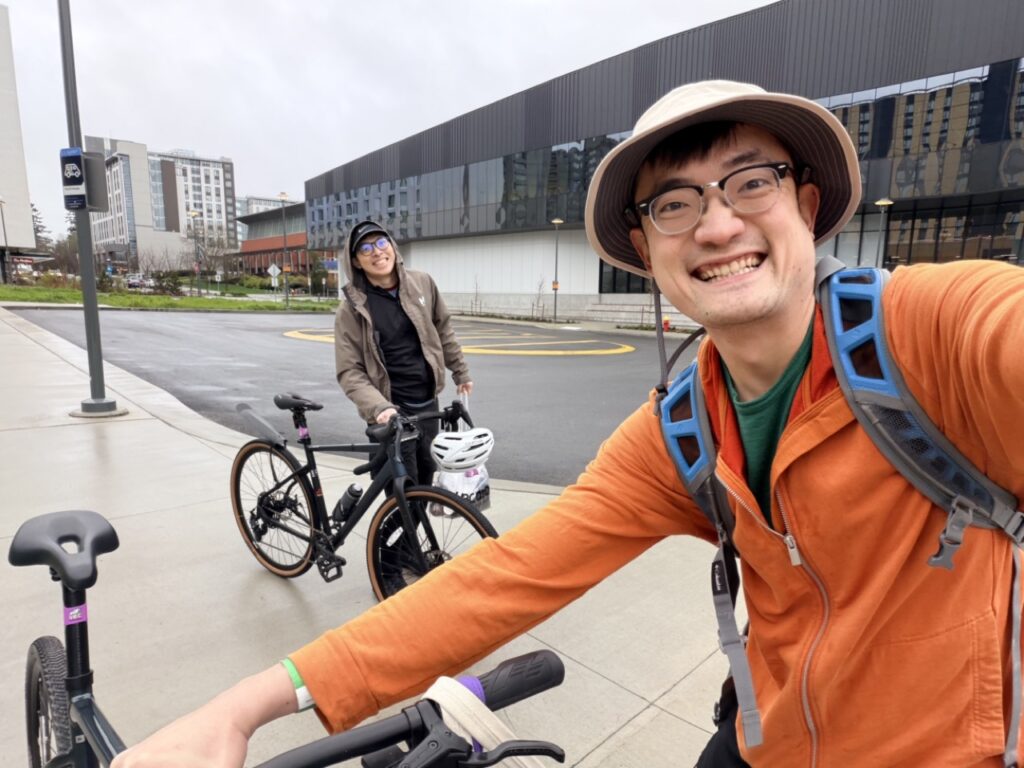
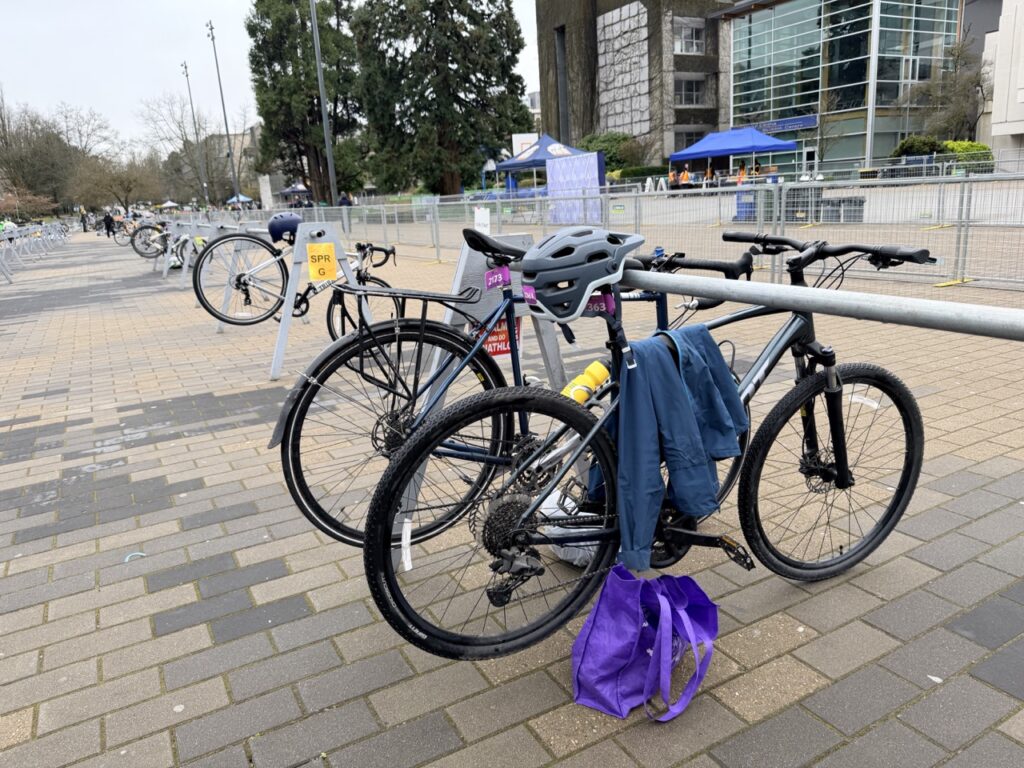
The pool swim used a “snake” system. For the sprint race, swimmers progressed across seven lanes for a total of 700m. You swim down and back in one lane, duck underneath the lane rope, and continue into the next one. Athletes enter the pool in quick succession.
I only realized a couple of weeks before the race that we would be swimming on the left side of the lane, which was opposite the normal etiquette I was used to, so I actually practiced approaching and turning at the wall from that side. It was awkward and I’m glad I didn’t do it for the first time during the race.
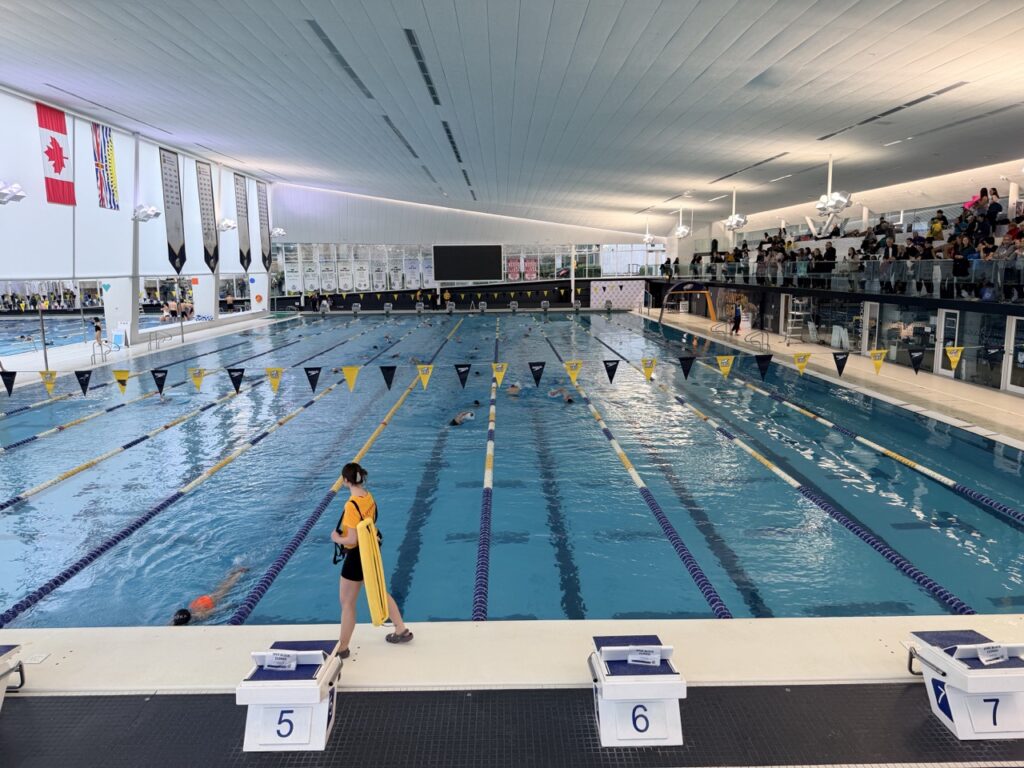
When it was finally my turn, I was so frazzled by being hurried into the water that I completely forgot to start my Garmin. I treaded water for several seconds fiddling with the watch and completely missed my push-off from the wall. The swimmer behind me must have been wondering why I had entered the race only to float directly in front of them.
Eventually I got going and found a rhythm, but pretty soon I ran into traffic. This was my one major complaint about the UBC swim setup: for some comical reason, the slower swimming waves started first. In tightly congested pool lanes with swimmers travelling in both directions and almost no room to pass, that created a problem.
Within a couple of laps I caught the back of the slower wave. I could either swim much slower than my normal pace or repeatedly sprint past people at a pace I couldn’t sustain. There wasn’t just one swimmer in front either. There was a whole line of people, including some doing head-up breaststroke. I decided to conserve my energy and accept the slower swim rather than repeatedly sprint and stop for the entire 700m. It was my first triathlon, and blowing myself up in the first discipline seemed like a poor strategy.


UBC Tri Du uses a dry-bag area between the pool and T1 so swimmers can change out of wet swimwear before heading to the bikes. Since I was already wearing a tri suit, I didn’t need to change. I had only left my glasses there, and in retrospect even that was unnecessary because I could have simply left them by the bike. Mark changed into dry cycling gear and spent about three additional minutes in the change area.
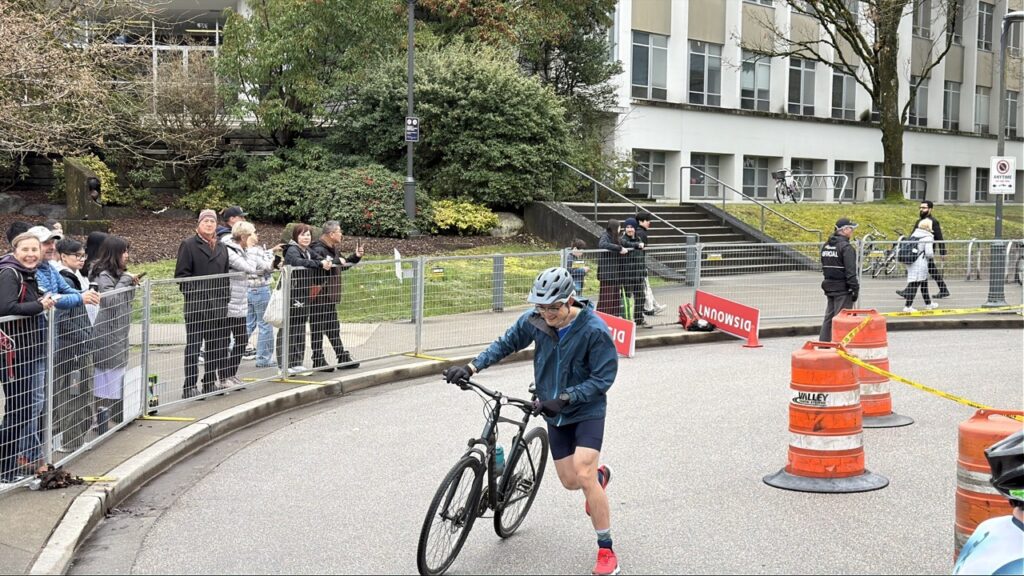
Then came another first-timer mistake. It was a brisk spring morning, so I decided to put on a windbreaker and cycling gloves for the bike. Except I forgot the gloves and had to run back with my bike to get them. Once I started riding, I warmed up quickly and regretted putting on the jacket, but the gloves were essential safety gear because numb fingers would not be very effective.
The bike itself was smooth, with some gentle hills, and it was satisfying to catch some people in my wave who had passed me in the pool. T2 was much more straightforward. I ditched the jacket, put on a T-shirt with the race bib already pinned to it, changed shoes and took off. Right after the race, I bought a race belt.
The final tally for my first race was:
| Leg | Result |
|---|---|
| Swim — 700m | 20:32 |
| T1 | 5:20 |
| Bike — 20km | 50:18 |
| T2 | 2:14 |
| Run — 5km | 29:34 |
| Total | 1:47:56 |
I was very happy with the result. I knew the swim didn’t really represent what I could do for 700m because of the traffic, and I could tighten my transition up substantially, but none of that really mattered. I had finished my first triathlon and genuinely had a blast doing it.
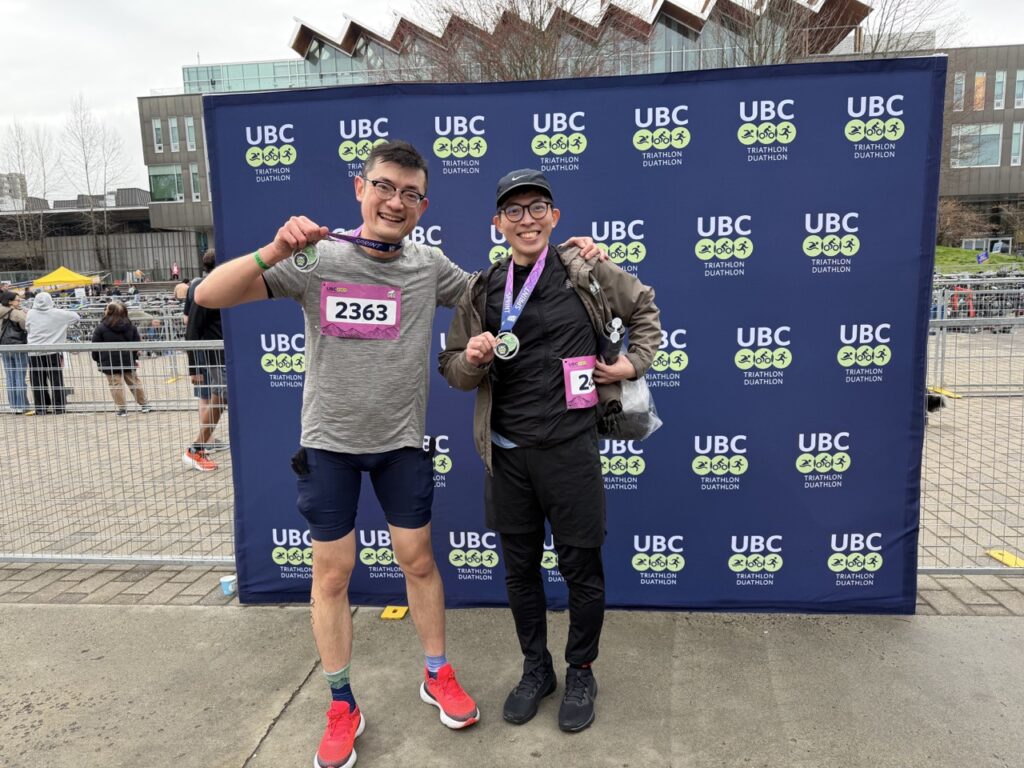
I also really enjoyed the training. Swimming, biking and running felt much more balanced across the body than simply adding more and more kilometres of running. If my legs were tired, I could swim. If I wanted aerobic exercise without pounding the pavement, I could ride. There was always something different to work on, and to feel productive about.
Riding on the pure euphoria and validation of finishing UBC Tri Du, I went home and signed up for my next triathlon the very next day: Vancouver T100.
This time there would be no swimming pool.
Prepping for an Open-Water Triathlon
Before really starting the T100-specific block, I had two more running races to finish: the Vancouver Sun Run and the BMO Vancouver Half Marathon. After the half marathon, I turned my attention back to the water.
Except this time it was a totally different beast: open-water ocean swimming.
At UBC Tri Du, I met another athlete who described trying an open-water triathlon at Stanley Park a few years earlier and completely freaking out as soon as he entered the murky, choppy ocean. He pulled out, took a DNF and swore off open-water triathlons. Apparently this is not an unusual experience.
A strong pool swimmer can still get a huge shock the first time they swim in open water. You can’t see the bottom, and sometimes you can’t see much farther than your fingers. There’s no black line to follow, no wall every 25 or 50m, other swimmers bump into you, and the wetsuit squeezes your chest and neck. Add cold water, waves, currents, sunlight and the psychological difference of being hundreds of metres from shore, and suddenly swimming the same distance is a very different experience.
Open-water swimming deserves respect, so I signed up for a six-week beginner course with Swim Smart. I think this is a really good way to get into the sport: gentle progression, straightforward instruction and a group of fellow learners at roughly the same level of discomfort.
We stayed close to shore at first and spent the first session mostly getting comfortable in our wetsuits. One of the surprisingly useful things I learned was just how buoyant a wetsuit is. If I felt uncomfortable, I could simply flip onto my back, relax and float.
We gradually added more swimming along with pointers on reduced kicking, higher arm recovery, reaching forward and sighting. Sighting is one of those skills that pool swimmers don’t have to think about at all. I practiced briefly lifting my eyes forward every 6-8 strokes, checking the next landmark or buoy and then getting my head back down, then breath on the side as a separate movement.
Each week we ventured farther from shore. By the end of the six-week course, we managed to swim 1,000m continuously without having to touch the bottom.
That was probably one of the biggest milestones of the whole year. The original question had been whether I could somehow survive a 750m swim. Now I had swum a kilometre in open water, and the question was slowly changing from can I finish this? to how fast can I reasonably race it?
Turning Camping Trips Into Swim Training
Besides the coached sessions, I tried to add as many open-water swims as I could manage. Camping at Alice Lake and Birkenhead Lake became swimming opportunities, along with day trips to Buntzen Lake, Kits Beach and Jericho Beach.
Some of these were places we had visited many times before, but adding swimming created a whole new dimension to them.
The open water didn’t become just easier. It became familiar and fun. I even found myself forgoing the paddleboard for the swimming wetsuit on some occasions.
Training the Bike and Run
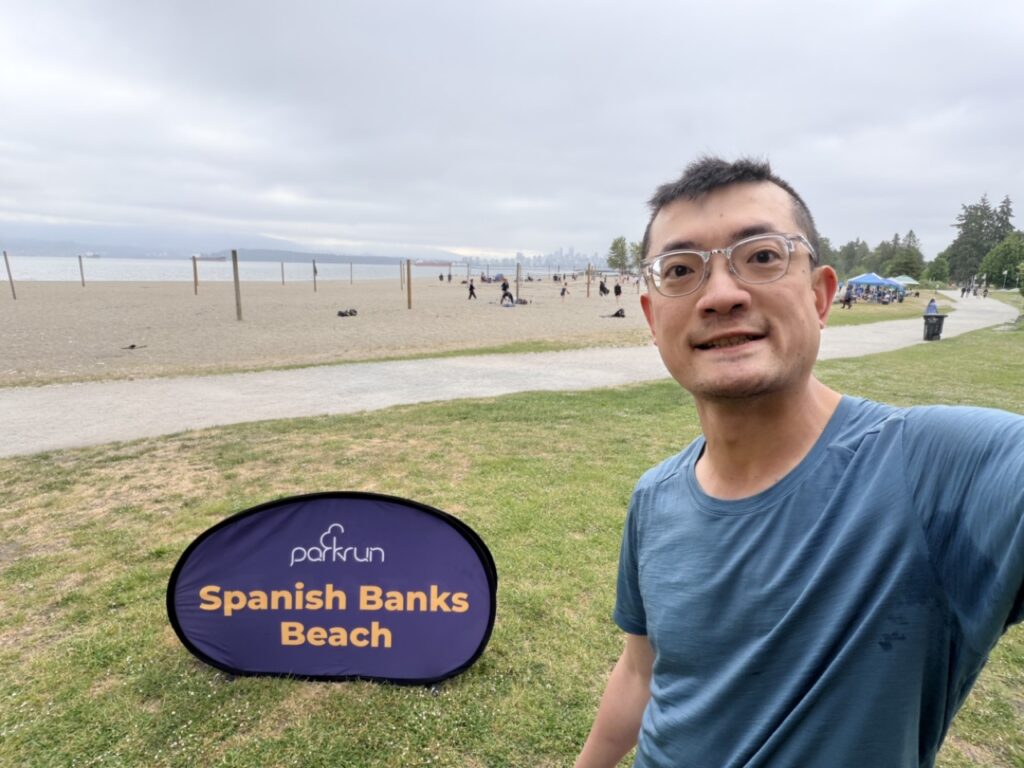
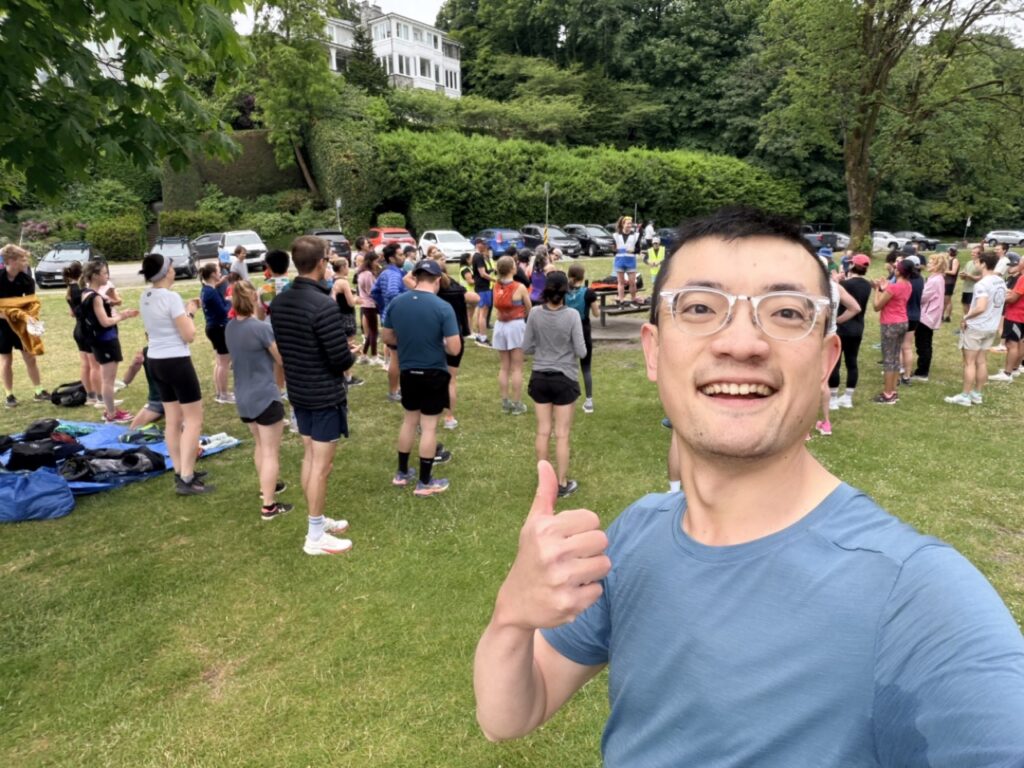
One nice thing about doing the BMO Half Marathon in May was that I started the summer with plenty of running fitness already banked, so I deliberately didn’t spend much of the T100 block running. I joined a few Parkruns for fun and occasionally turned them into bike-run-bike workouts: ride there, run the 5K, and ride home.
That introduced another important part of triathlon training: the brick.
Running 5km is quite straightforward when you start with fresh legs. Running immediately after cycling hard for 20km feels completely different. The first few minutes can feel weird, with heavy legs and an awkward stride, so I used short bricks to make that sensation familiar.
That worked quite well. By T100, I expected the jelly legs rather than being surprised by them.
My right calf still threatened to cramp shortly after getting off the bike, though, and that has happened more than once now. So that’s one of the loose ends from this first season. More bike-to-run adaptation, calf strength and endurance, cycling position and cadence, and race-day hydration and fueling are all things worth continuing to work on.
Cycling was probably where I had the most room to make gains. Compared with running, I was starting from a much less developed cycling base, so I added stationary-bike workouts and kept up a roughly weekly bike commute. Some sessions also became more structured, starting with shorter blocks at a strong but controlled effort and gradually progressing toward longer race-specific intervals.
Instead of simply hammering every ride, the basic pattern became fairly simple: easy riding built volume, harder intervals helped with speed, and bricks taught me to run afterward.
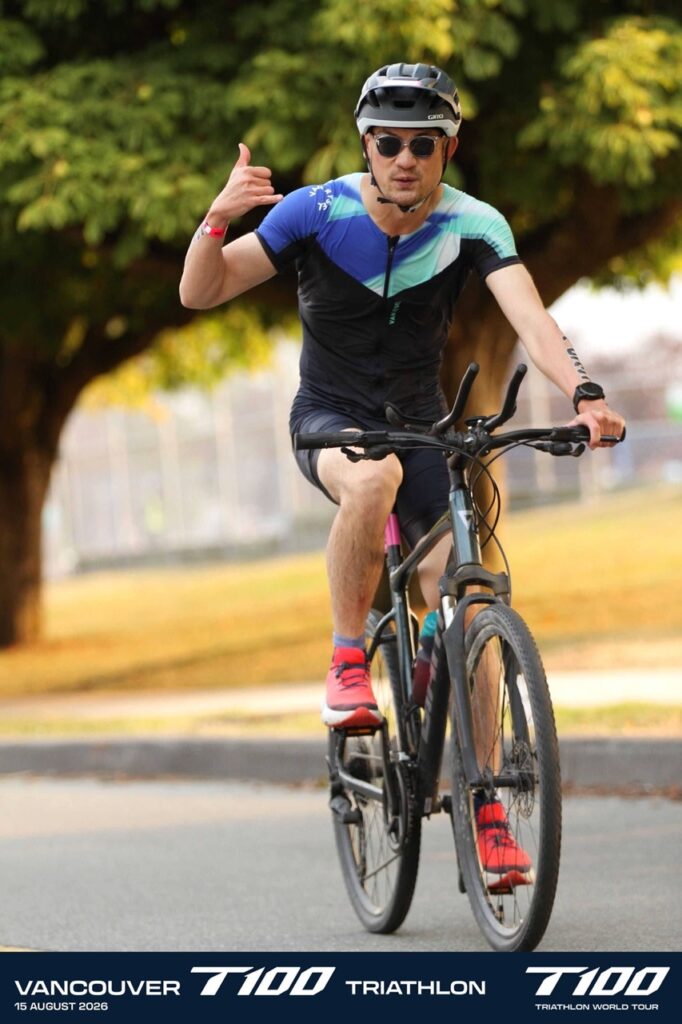
I was still riding my aluminum hybrid bike, not a $10,000 carbon-fibre triathlon machine, although I did add a pair of inexpensive clip-on aerobars. They looked slightly ridiculous on the hybrid but were actually useful on the faster, flatter sections. Getting the torso lower reduces aerodynamic drag, which matters more and more as speed increases.
Mock Triathlons and Race-Specific Practice
Probably the most valuable workouts in the final few weeks weren’t the hardest ones. They were the ones that most closely resembled race day.
I did a couple of mock sprint triathlons and practiced on the actual T100 course. I did one with the Swim Smart group, and another one with friends I met in the group. The social aspect of the triathlon culture was great.
Most importantly, I was no longer guessing what happened between each discipline. I knew what it felt like to swim and then bike, and to bike and then run. I knew the hills. I knew where the aerobars were useful. I knew the first kilometre of the run would feel awkward and didn’t need to panic about it. And I knew I could finish it.
Instead of hoping for some magical race-day performance, the goal became to reproduce things I had already done in training.
Vancouver T100 Triathlon
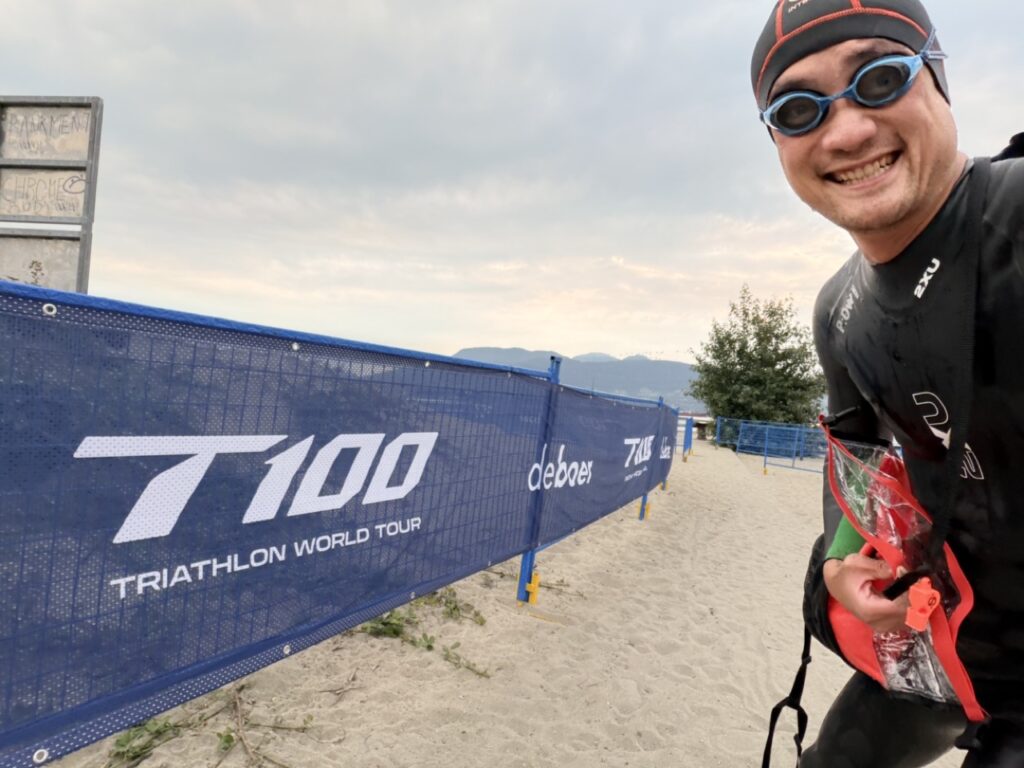
The week before the race, I joined the event WhatsApp group. Hundreds of racers ranging from seasoned triathletes to complete novices were asking and answering questions, offering encouragement, lending spare race belts and organizing informal practice swims.
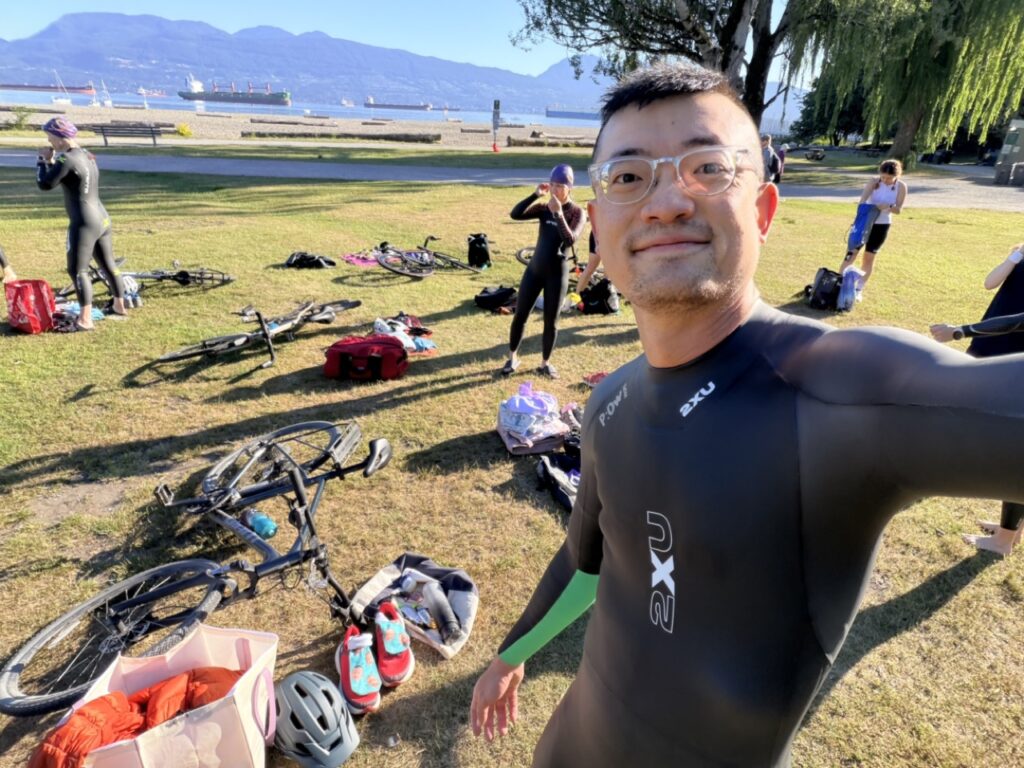
I joined a 6:30am swim at the actual race venue, and that turned out to be another useful bit of preparation. When I stood on the same beach on race morning a few days later, the place already felt familiar.


My alarm was set for 5am, but I was restless and already awake before it went off. I kept things close to normal: coffee and two pieces of toast with peanut butter and jam, which I knew my stomach could tolerate.
My support crew got up soon afterward. I was incredibly thankful that Tina and all three kids were coming to support me from beginning to end. Having family there helped psychologically but was also reassuring logistically. If parking had been difficult, Tina could have dropped me off. I could leave my phone and key with her. In the future, I could even wear sandals while waiting for the swim and hand them over on the beach instead of wandering around barefoot.
And the 3 boys were the cutest and youngest cheering squad on the wee hours of the morning, getting lots of compliments from others.
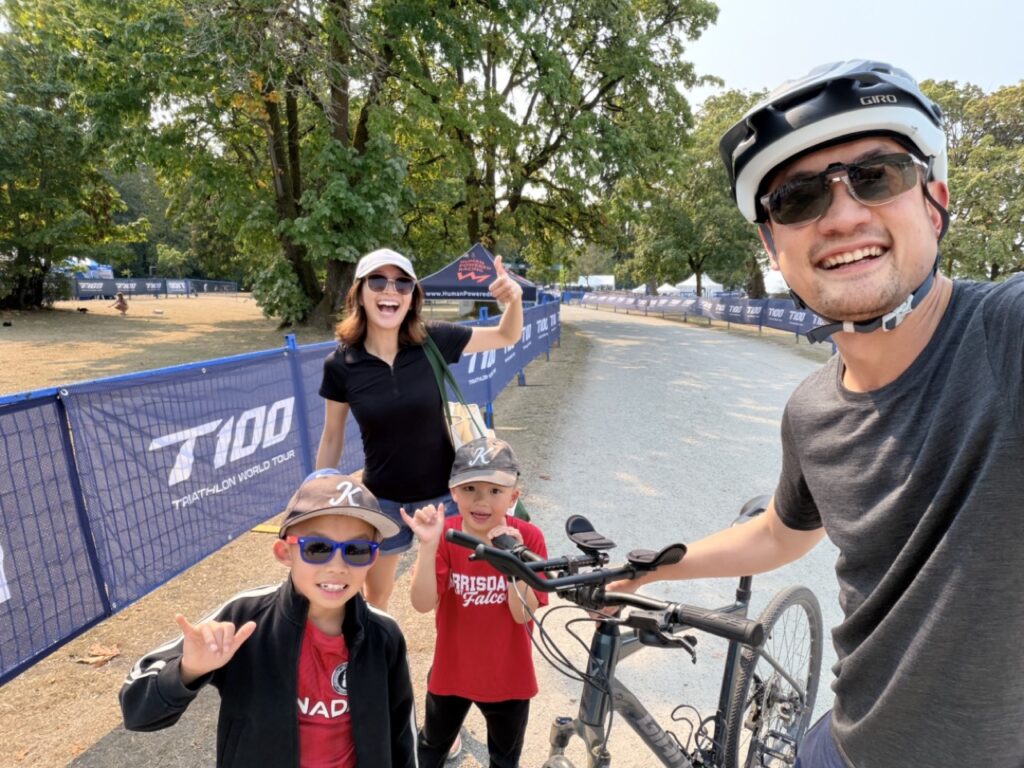

I did a final check at transition and mentally ran through the sequence a few times. I also checked exactly where I would enter transition after the swim and where I would leave with the bike. That sounds basic, but transition areas look quite different when you’re wet, breathing hard and surrounded by several hundred nearly identical bicycles.
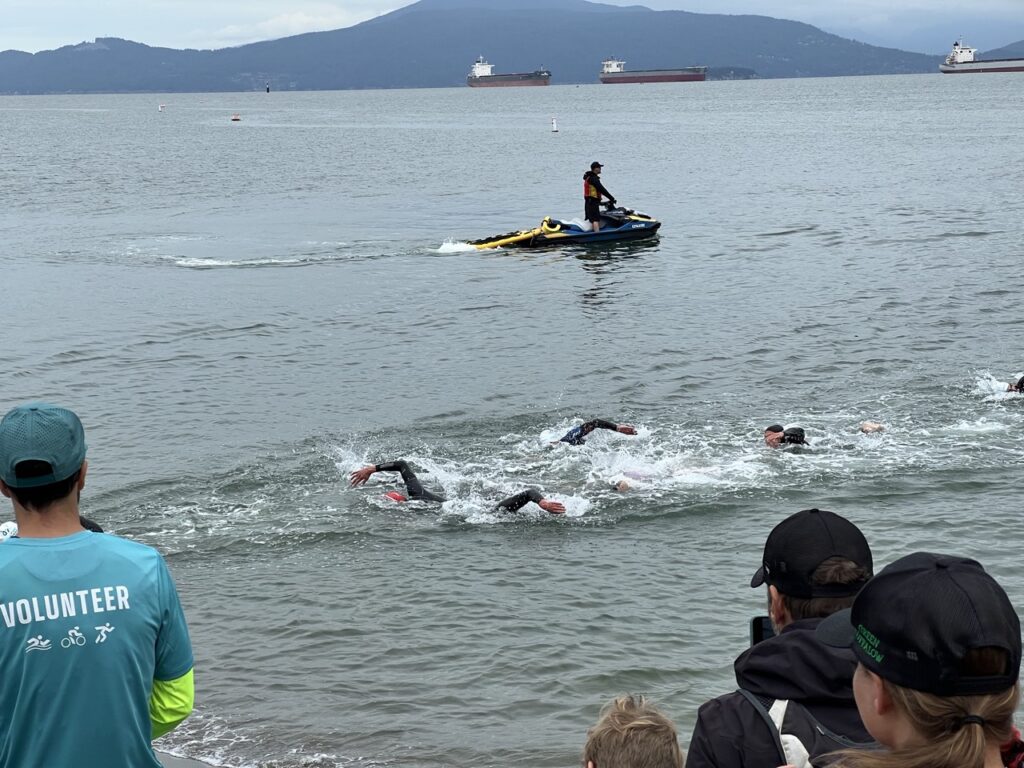
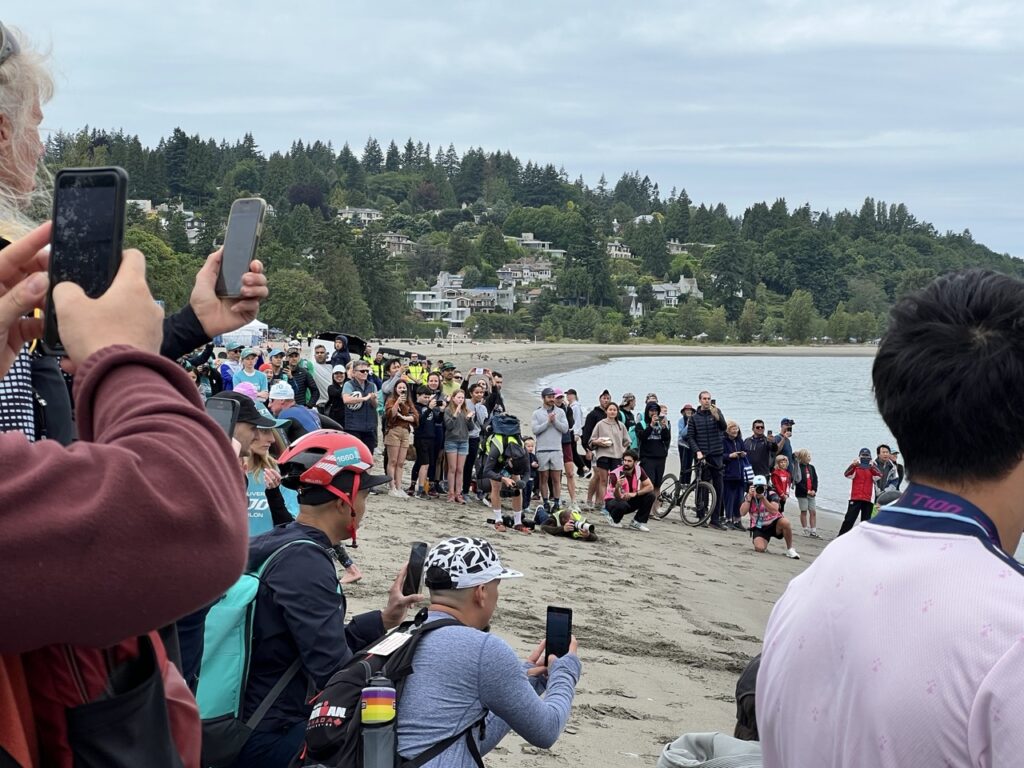
I ate a gel about 45 minutes before the start and made a few more trips to the toilet to ensure optimal comfort, then met my crew on the beach and watched the Olympic-distance racers finish their swim. They had started at 6:30am.
The Swim
Athletes were divided into colour-coded waves based on estimated swim times. Faster swimmers started first, as they should—@UBC Tri Du—and people entered the water in pairs at short intervals to spread the field out.
I had estimated a swim time around 21 minutes and deliberately positioned myself at the back of my wave. That decision worked really well. I avoided the entire dreaded open-water “washing machine” of swimmers bumping, elbowing, splashing and kicking each other. Most of the time there were only one or two people immediately around me, and we generally only got close when someone drifted off course or made a pass.
The T100 swim buoys were enormous and easy to see. Predictably, I started a little fast because of the adrenaline and because the family was watching and cheering. But I recognized the rising breathing rate quickly and backed off just enough to settle things down.
That was one of the things I was happiest about afterward. A year earlier, when my breathing got out of control in a pool, the solution was often to switch to breaststroke and look for the wall. Now I was in the ocean, recognized the problem, adjusted my effort and kept swimming.
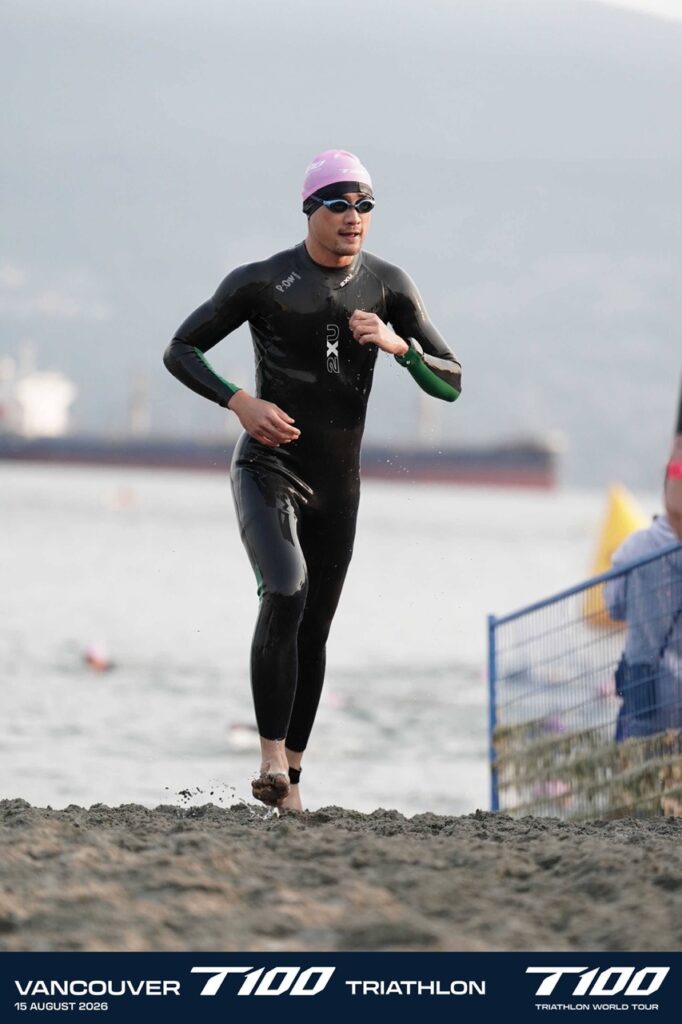
I came out of the water in 20:03, almost exactly where I thought I would.
T1
I ran into transition and went through the routine I had practiced. Wetsuit off, glasses, socks, shoes, helmet and bike.
Compared with UBC, there weren’t many decisions to make anymore. I wasn’t wondering whether I needed a jacket or running backward looking for forgotten gloves. Everything had a job and everything had a place.
Then it was time to ride.
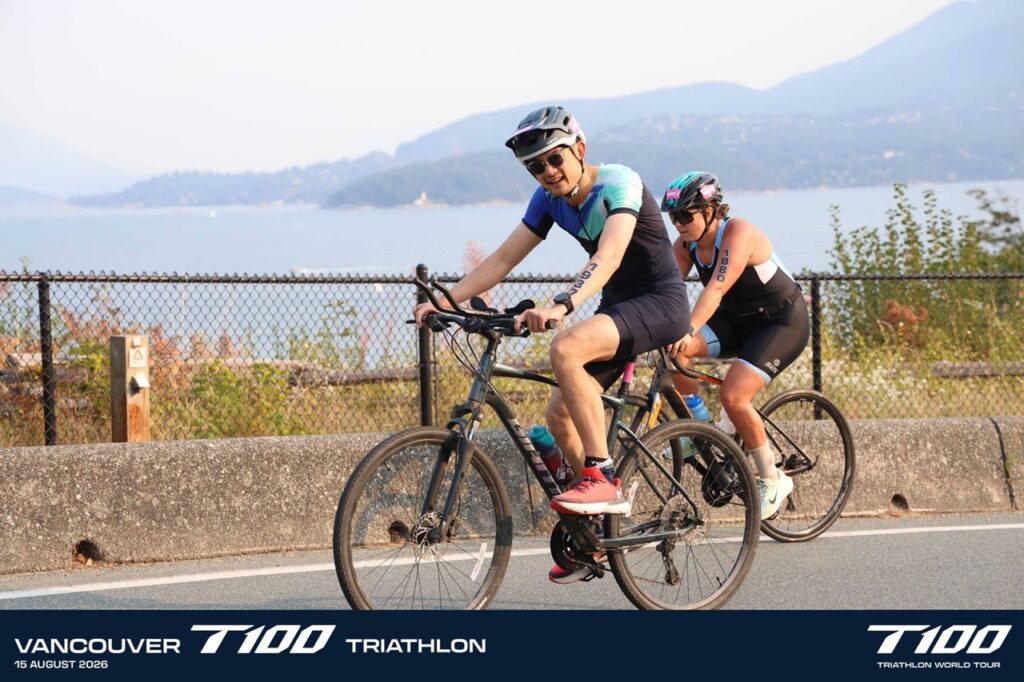
The Bike
The bike leg turned out to be the most confusing part of the race. Road construction on Marine Drive forced a substantial detour onto West 4th Avenue before looping back toward Marine Drive. That created a surprisingly inconspicuous decision point where riders either had to make a sharp hairpin into a parking lot to complete the loop or continue toward transition.
I had studied the map and even ridden the course beforehand, and I was still unsure whether I was at the correct parking lot when I reached it during the race. I asked the volunteers as I approached. Apparently multiple athletes missed the turn and either had to ride back or didn’t complete the prescribed course.
So one lesson from the race was that course knowledge matters. Another is that signage matters too.
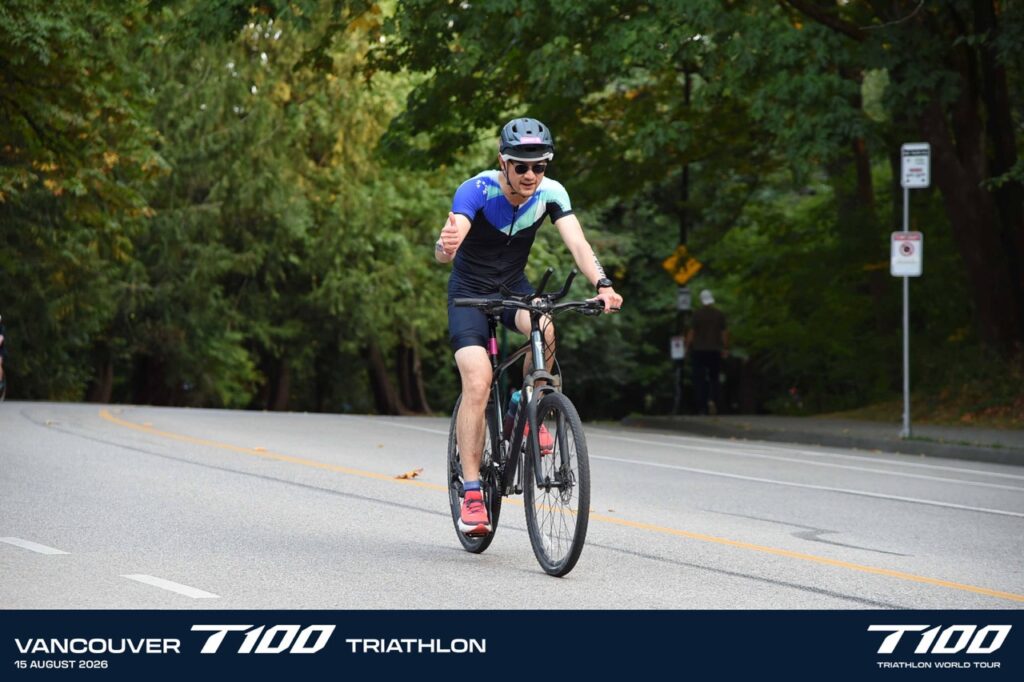
Once I knew I was going the right way, the riding went well. I felt considerably stronger than I had at UBC despite the T100 course being hillier. Some of the faster riders absolutely ripped down the descents, probably north of 50km/h, which was somewhat intimidating on my hybrid bike. I stayed to the right, held my line and let the missiles go past.
Because it was a non-drafting event, I was also trying to respect the draft zone and complete passes promptly instead of sitting directly behind another cyclist. That required more thought than I expected. Sometimes I would begin considering a pass only to hear a bike roaring up from behind at dramatically higher speed and decide that maybe I would pass the person later.
The cheap aerobars were especially useful on the faster sections. I came into T2 feeling like I had ridden hard but hadn’t completely emptied the tank.
The result was 20.1km in 47:52, averaging 25.2km/h, noticeably faster than UBC despite the more difficult terrain.
The Run
I got off the bike and, exactly as expected, my legs felt weird. My right calf also started flirting with a cramp again, but none of it caused much concern because I had experienced these sensations during training. I resisted trying to force my normal 5K stride immediately and spent the first few minutes letting the legs become running legs again.
Once I settled in, I gradually increased the pace and found another runner going around the speed I wanted. I locked onto him and thought I was doing pretty well keeping up.
Then we reached the final turn. I turned left toward the finish line.
He kept going.
Ah.
He was doing the Olympic race and had another lap to complete!
No matter. The finish line was close enough at that point that I didn’t spend time worrying about my 5k pace being his 10k pace. I pushed the final stretch hard.
The result was 5.1km in 26:51, about 5:15/km.


The Finish
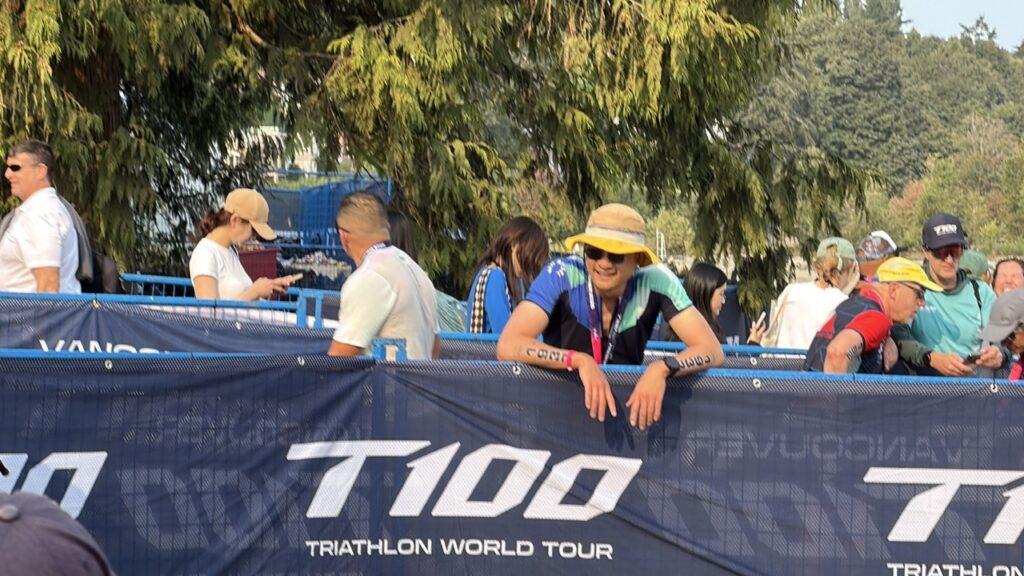
Tina and all three kids were waiting at the finish line, and even my dad had joined the support crew and come out to cheer.
I crossed the line in 1:41:55.
My first open-water triathlon was finished, and it had gone almost exactly according to plan.
UBC Tri Du vs. Vancouver T100
Looking back, the comparison between the two races probably shows the training progression better than anything else.
| UBC Tri Du — March | Vancouver T100 — August | |
|---|---|---|
| Swim | 700m — 20:32 | 750m — 20:03 |
| Swim pace | 2:56/100m | 2:40/100m |
| T1 | 5:20 | 4:33 |
| Bike | 20km — 50:18 | 20.109km — 47:52 |
| Bike speed | 23.9km/h | 25.2km/h |
| T2 | 2:14 | 2:37 |
| Run | 5km — 29:34 | 5.116km — 26:51 |
| Run pace | 5:55/km | 5:15/km |
| Total | 1:47:56 | 1:41:55 |
The total improvement was 6 minutes and 1 second, but that actually understates the difference. At T100 I swam an additional 50m in open water and still finished the swim 29 seconds faster. My swim pace improved by roughly 9%. Average cycling speed improved by about 6% despite the harder course, and the run pace improved by about 40 seconds per kilometre even though it came after the harder bike leg.
None of those gains came from one magical workout. They came from lots of fairly ordinary ones.
Lessons From the First Year
Looking back at the year from the 2025 T100 Sun Up 5K to actually racing the T100 myself, the biggest lesson is probably that consistency mattered much more than any individual workout. My swimming improved because I kept going back to the pool and the ocean.
Technique also mattered much more in swimming than I initially appreciated. At first I assumed my problem was simply cardiovascular fitness. That was part of it, but I was also wasting an enormous amount of energy fighting the water. Learning to relax, streamline, breathe properly, reduce unnecessary kicking and keep my body more horizontal made slow swimming possible. Wet suit and the salt water definitely helped with buoyancy, and the open water doesn’t tempt you with wall to hang on for a breather. Once easy swimming actually became easy, building endurance became much more straightforward. Having said that, I still want to break out of my current 2:30 pace so I signed up for more swimming lessons for the fall.
The training block also reinforced the value of spending more time on your weaknesses instead of endlessly training what you’re already good at. Coming off the half marathon, running was already my strongest discipline. Most of the potential improvement was in swimming and biking, so that’s where I spent more of my time. Both improved substantially, while the run improved anyway.
Brick workouts were valuable too, although not necessarily because they dramatically improved fitness. Their biggest benefit was making a weird sensation feel normal. The first few minutes of running after cycling still feel strange, but now I expect that. The jelly legs no longer mean anything has gone wrong. The recurring near-cramp in the right calf is still something I need to work on.
Race-specific practice probably gave the best return in the final weeks. Knowing I could swim 750m wasn’t as reassuring as having swum in the actual ocean. Knowing I could bike 20km wasn’t as useful as riding the hills on the actual course. Knowing I could run 5km wasn’t the same as running it immediately after cycling.
Transitions rewarded simplicity. My first race involved a dry bag, glasses, gloves, a jacket and a separate T-shirt with the bib attached. By T100 I was trying to eliminate anything that involved a decision. Lay the equipment out in order, know what comes next and don’t bring things you don’t need.
Finally, I really like how balanced triathlon training feels. Swimming works the body very differently from running, cycling lets me accumulate a lot of aerobic exercise without the same impact load, and running remains the simplest test of fitness. Add some strength training and there aren’t many parts of the body being completely neglected. From a long-term health and longevity perspective, that combination appeals to me just as much as racing.
The numbers are fun too, of course, and I like seeing objective evidence that I got faster. But the best parts of the year were scattered throughout the process: swimming laps with Tina while we both tried to figure out front crawl, looking for hotel pools on vacations, turning family camping trips into open-water practice, riding to Parkrun, and standing on a beach at 6:30 in the morning with a bunch of strangers who all thought swimming in the ocean before breakfast sounded like a good idea.
A year earlier, we had stood beside the same race weekend watching the professionals and thinking, maybe we can do this too.
Turns out we could tri.


What’s Next?
The funny thing about crossing a finish line is how quickly your brain starts moving it farther away.
A year ago, 750m of swimming sounded impossible. Then the goal became finishing UBC Tri Du. Then it became finishing an open-water sprint. Eventually it became seeing how well I could actually race one.
My next target is the Olympic-distance at UBC Tri Du and T100: 1.5km swim, 40km bike and 10km run.
Double the swim, double the bike and double the run. Looking at those numbers now produces a very different reaction than 750m did a year ago.
It doesn’t look impossible anymore. It just looks like something that needs training.
And an even bigger milestone? Tina is in for her first sprint tri too.
Let’s GO!
Discover more from Outdoor Family
Subscribe to get the latest posts sent to your email.
Well done bro!! Super impressive results!!